
Our September bus trip was to the Eastney Engine Houses Open Day.
The Engine Houses form part of a Scheduled Ancient Monument and the buildings are all Grade II listed. These buildings include the 1865 pump house and boiler house; the 1887 boiler house, pump house and chimney; and the 1904 gas engine house
The Engine Houses were built because Portsmouth desperately needed proper sewage disposal provisions. As the city is built up on a low-lying island it has poor natural drainage. This resulted in waste and sewage frequently polluting the water supply - sounds familiar - which resulted in many deaths from cholera and other diseases. Whilst a new drainage system was introduced in 1868, population increases meant significantly more power and capacity was soon required - and so the Eastney Engine Houses were built. As well as being an engineering marvel, they also played an important part in improving the health and living standards of everyone in Portsmouth. When they were retired from normal use, the beam engines were kept in operating condition as a backup until 1954. Maintenance of the engines and pumps was discontinued after 1954. Following extensive restoration, the Beam Engine House was opened as an industrial museum in 1972 and is now open to visitors on selected weekends alongside the Gas Engine House, also on site.
The Beam Engine House is an impressive Victorian building designed by Sir Frederick Bramwell and finished in 1887. It houses a pair of classic Boulton Watt beam engines and pumps which have been restored to their original 1887 condition. Next door you can see the boilers that produced steam to drive one of the two beam engines. These boilers also produce steam for some of the smaller engines displayed nearby. Originally there were four enormous Lancashire boilers that occupied most of the space. Displayed on the mezzanine level above the boilers are other small pumps which were usedlocally.
The pump house contains the two Boulton and Watt beam engines which operated the pumps that kept Portsmouth's sewage system functioning. The space is dominated by the wooden casings for the pistons and the rods leading to the pumps, as well as the flywheels that regulate the engines' speed. Much of the building's internal structure is made of iron, and the windows are housed in cast iron. On the upper level you can see the crane used to lift the beams out for maintenance.
Please note that the Engine Houses are industrial sites dating back to the Victorian era. There is an uneven surface outside all the way to the doors of each Engine House. The Gas Engine House can only be accessed down ten steps. There are handrails on both sides. Inside the floor is uneven in places. From the boiler area the rest of the museum can only be accessed via very steep steps.
After our short visit to the Eastney Engine Houses went back to The Hard for lunch at one of our favourites - The Ship and Castle.
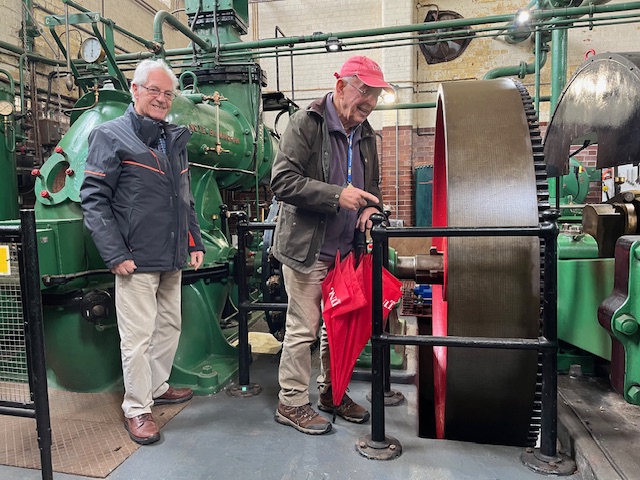


Click on the first image to open the gallery then use the < > to scroll through,